

Original Wabi Sabi Wall Art for Modern Homes: The Complete Guide to Imperfect Beauty
What Is Wabi Sabi Wall Art? (Quick Answer)
Wabi sabi wall art is handcrafted artwork — typically made with natural materials like plaster, raw canvas, and organic pigment — that embraces imperfection, asymmetry, and the visible marks of the process as core parts of its beauty, rather than flaws to hide. It's rooted in the Japanese aesthetic philosophy of wabi sabi, which finds meaning in transience, roughness, and things that look honestly made rather than mechanically perfect.
If you're furnishing a modern home and keep gravitating toward textured, earthy, slightly imperfect pieces over glossy printed canvases, you're already responding to wabi sabi principles — even if you didn't have a name for it yet.
Let's get into what actually makes this style work, why it's having a real moment in contemporary interiors, and how to choose a piece that will still feel right on your wall five years from now.
The Philosophy Behind Wabi Sabi
Wabi sabi isn't a decorating trend that was invented for Pinterest — it's a centuries-old Japanese worldview with roots in Zen Buddhism. "Wabi" originally referred to the quiet melancholy of a simple, solitary life; "sabi" described the beauty that comes with age and wear. Over time the two merged into a single aesthetic principle: things are more beautiful, not less, because they are imperfect, incomplete, and impermanent.
That's a genuinely different starting point than most Western design traditions, which have historically prized symmetry, polish, and permanence. A wabi sabi ceramic bowl with a visible repair line isn't considered damaged — it's considered more valuable, because the repair (often done with gold, in the kintsugi technique) becomes part of the object's story.
Translate that into wall art, and you get pieces that:
- Show the texture of the tool or hand that made them
- Use uneven, organic edges instead of crisp, mechanical lines
- Rely on muted, earthy, sometimes inconsistent color rather than flat, uniform pigment
- Are accepted (even celebrated) for cracking, settling, or aging differently over time
This matters for a practical reason, too: it means wabi sabi art was never designed to look "finished" in the way a factory print is finished. It's designed to look alive.
What Makes Wall Art "Wabi Sabi" vs. Just "Textured" or "Abstract"
Here's where a lot of shoppers get tripped up, and honestly, a lot of retailers blur the lines on purpose. Not everything textured is wabi sabi, and not everything abstract is wabi sabi either. The distinction actually matters if you want the real thing.
The short version: if a piece could be reordered in the exact same pattern, it isn't wabi sabi — it's just textured decor styled to look like it. True wabi sabi pieces resist exact repetition by design.
Why Wabi Sabi Wall Art Fits So Naturally Into Modern Homes
Modern interior design has been drifting away from stark minimalism for a few years now, and wabi sabi is a big part of why. Pure minimalism can feel cold if you push it too far — all clean lines, no soul. Wabi sabi solves that problem without abandoning the modern aesthetic.
A few reasons this pairing works so well:
- Neutral palettes integrate everywhere. Soft whites, warm greys, sandy taupes, and muted charcoals sit comfortably in Scandinavian, Japandi, organic modern, and contemporary interiors without fighting other design elements in the room.
- Texture replaces color as the visual interest. In a minimalist room with limited color variation, a heavily textured plaster piece becomes the focal point purely through shadow, light, and surface — not loud hues.
- It photographs and lives well in natural light. Because these pieces rely on dimension rather than flat color, they shift subtly throughout the day as light moves across the surface — something a flat print simply can't do.
- It ages with the home, not against it. As furniture and finishes settle in and develop their own patina, a wabi sabi piece doesn't clash the way a trend-driven graphic print eventually does.
This is really the core appeal for design-conscious buyers: wabi sabi art doesn't compete for attention, but it also doesn't disappear into the background. It anchors a room.
Materials & Techniques: What Goes Into an Authentic Piece
This is where the "handcrafted" claim either holds up or falls apart, so it's worth understanding what you're actually paying for.
Common materials in genuine wabi sabi wall art include:
- Lime plaster — a breathable, naturally-textured material that's been used in architecture and art for centuries; it cracks and settles in its own unpredictable rhythm, which is part of the appeal rather than a defect.
- Raw or unprimed canvas — allows pigment to absorb unevenly, creating natural variation piece to piece.
- Natural pigments and clay-based color — mixed in small batches, meaning the "same" shade will shift subtly from one artwork to the next.
- Sand and organic aggregate — added into the surface for tactile depth, so the piece has real dimension you can feel, not just see.
The process itself tends to be slow by necessity:
- Layers are built up gradually rather than applied in one pass.
- Texture is added, partially removed, and reshaped by hand across multiple stages.
- The piece is allowed to cure and settle naturally — rushing this step is what produces artificial-looking "fake texture" instead of authentic wabi sabi surface.
- Final detailing responds to how the material actually behaved, not a pre-set template.
This is also why authentic wabi sabi pieces are more time-intensive (and typically more expensive) than printed or mass-textured alternatives — there's no shortcut that preserves the organic unpredictability that defines the style.
Room-by-Room Guide: Where Wabi Sabi Wall Art Works Best
One of the most common questions people ask is simply: where do I actually put this? Here's a practical breakdown by room.
Living Room
The living room is usually the highest-impact placement — above a sofa, console, or fireplace. A single large-scale piece tends to outperform a cluster of smaller ones here, especially in open-plan modern layouts where the art needs to hold its own from across the room.
Bedroom
Because wabi sabi pieces lean calm and grounding rather than visually loud, they work well in spaces meant for rest. Avoid placing a heavily textured piece directly above the headboard if the room already has a lot of tactile bedding — you want the texture to read clearly, not compete with itself.
Entryway
This is an underused but high-value spot. An entryway piece sets the tone for the entire home in the first five seconds someone walks in, and a wabi sabi piece communicates intention immediately — this is not a generic rental unit, someone thought about this.
Home Office
Home offices can feel sterile fast, especially with a lot of hard surfaces (desk, monitor, shelving). A textured, earthy piece softens that without adding visual clutter or distraction.
Dining Room
Dining spaces benefit from art that rewards a second look, since people spend extended time facing it during meals. Texture-rich pieces tend to hold interest longer than flat prints in this context.
How to Choose the Right Piece for Your Space
A few practical filters, in order of importance:
- Start with mood, not color. Decide what you want the room to feel like first — grounded and still, or more dynamic and energizing. Wabi sabi pieces generally lean toward stillness; more brushwork-driven abstract pieces can add movement.
- Prioritize scale over pattern. In modern interiors, one well-sized piece almost always beats several smaller ones for visual impact. When you're unsure, size up rather than down.
- Let texture lead in minimalist rooms. If your space is already sparse, a heavily textured plaster piece adds depth that flat color alone can't provide.
- Don't second-guess the imperfections. A visible crack, an uneven edge, or an intentionally raw surface isn't a manufacturing flaw — that's the style doing exactly what it's supposed to do.
- Think about lighting. Textured pieces respond dramatically to directional light. Flat overhead lighting will mute the effect somewhat, so consider your room's light sources before committing to a heavily dimensional piece.
A Practical Example: Choosing a Piece for a Real Room
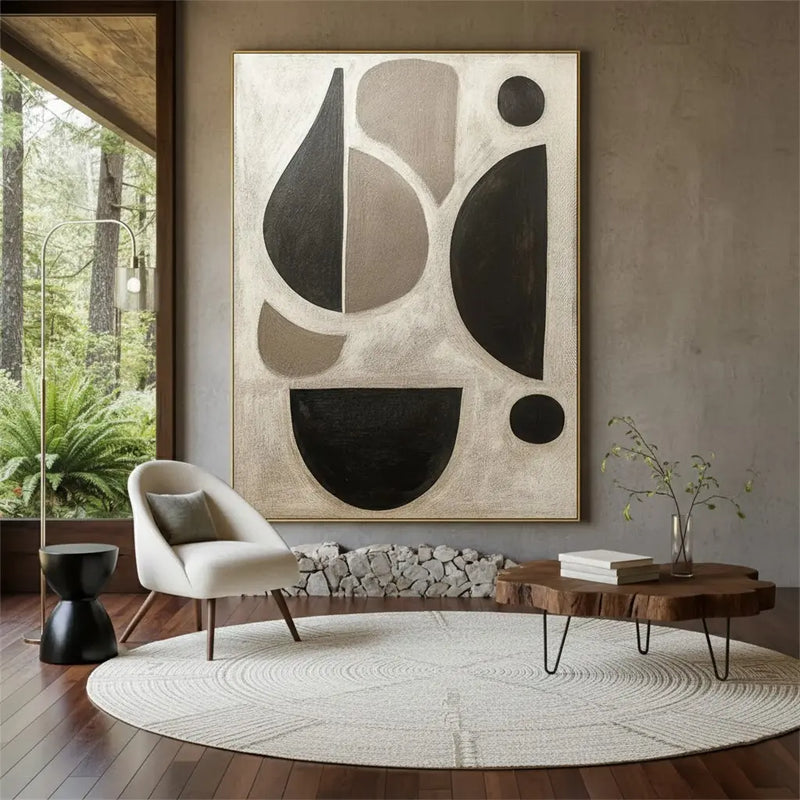
Say you're working with a fairly typical modern living room — light oak flooring, a linen-upholstered sofa in warm grey, black metal accents, and a lot of natural light from a west-facing window. This is a very common baseline in contemporary homes right now, so it's worth walking through.
In a room like this, a large-format plaster piece in warm taupe or soft charcoal tends to work better than something in stark white, because it picks up the warmth already present in the oak and linen rather than introducing a colder, more clinical note. Positioned above the sofa at roughly two-thirds the width of the furniture below it, the piece catches the afternoon light from that west-facing window directly, which is exactly the kind of shifting, dimensional effect that makes textured plaster worth choosing over a flat print in the first place — the surface will look different at 10am than it does at 6pm, and that's a feature, not an inconsistency.
That's the kind of decision-making worth applying to your own space: match undertone to your existing materials, size generously, and think about how your specific light will interact with the surface before you buy.
Wabi Sabi Art vs. Mass-Produced Prints: A Direct Comparison
Neither option is "wrong" — a print can absolutely be the right budget-conscious choice for some spaces. But if you're specifically drawn to wabi sabi aesthetics, an original handcrafted piece is the only way to actually get the texture, variation, and depth that define the style. A printed reproduction of a textured piece, by definition, flattens out the exact quality that made the original worth having.
Caring for Textured and Plaster-Based Wall Art
Because these pieces use natural materials, they need slightly different care than a standard framed print:
- Keep away from direct moisture and high-humidity rooms — bathrooms and unventilated kitchens aren't ideal locations for plaster-based pieces.
- Dust gently with a soft, dry cloth. Avoid wet wiping textured surfaces, which can affect natural pigment.
- Skip harsh cleaning products entirely on raw plaster or clay surfaces — they're not sealed the way a printed canvas is.
- Handle with care during moves. Textured, dimensional surfaces are more vulnerable to edge damage in transit than a flat print, so professional wrapping is worth the extra step for larger pieces.
Treated properly, these pieces are genuinely durable — lime plaster in particular has a multi-century track record in architecture — but they do reward a bit more attentiveness than a printed poster would.
Frequently Asked Questions
Is wabi sabi wall art the same as "textured" wall art?
Not necessarily. Textured decor can be machine-embossed or mass-produced, while authentic wabi sabi art is handcrafted individually, meaning no two pieces are exactly alike. All wabi sabi art is textured, but not all textured art is wabi sabi.
Will wabi sabi art match my existing color scheme?
Most authentic pieces use neutral, earthy palettes (soft whites, warm greys, sandy taupes, muted charcoals) specifically because these tones are designed to complement a wide range of modern interior styles rather than dictate one.
How do I know if a piece is genuinely handmade versus printed to look textured?
Ask directly about the process and materials. Genuine pieces will typically involve plaster, natural pigment, canvas, or clay, applied in multiple hand-worked layers — and the seller should be able to describe that process specifically, not just say "textured finish."
Does wabi sabi art work in small spaces, or only large open-plan rooms?
It works in both. Smaller wabi sabi pieces suit hallways, reading nooks, and gallery-wall arrangements just as well as large-scale pieces anchor bigger rooms — the philosophy scales, the size doesn't have to be dramatic to be effective.
How much should I budget for an original, handcrafted piece?
Pricing varies significantly by size, material complexity, and maker, but expect original handcrafted work to cost more than a printed canvas of comparable size, since you're paying for labor-intensive, small-batch production rather than volume manufacturing.
The Bottom Line
Wabi sabi wall art isn't about chasing a trend — it's a genuinely different philosophy about what makes something beautiful, applied to a wall. For modern homes that already lean toward natural materials, neutral palettes, and considered design, it's one of the most durable (in every sense) choices you can make, because it's built to age well rather than go out of style.
Ready to bring an original piece into your space?
Shop the Wabi Sabi CollectionLast updated: September 18, 2026